Bhandara Verified
Wainganga Solar Works
वैनगंगा सोलर वर्क्स
1.5–25 kW
MSEDCL
Empanelled
2018
Established
6+
Installs
—
No reviews yet
Quick facts
At a glance
Service area
Bhandara, Tumsar, Sakoli…
Capacity range
1.5–25 kW
Established
2018
Languages
mr-IN, hi-IN, en-IN
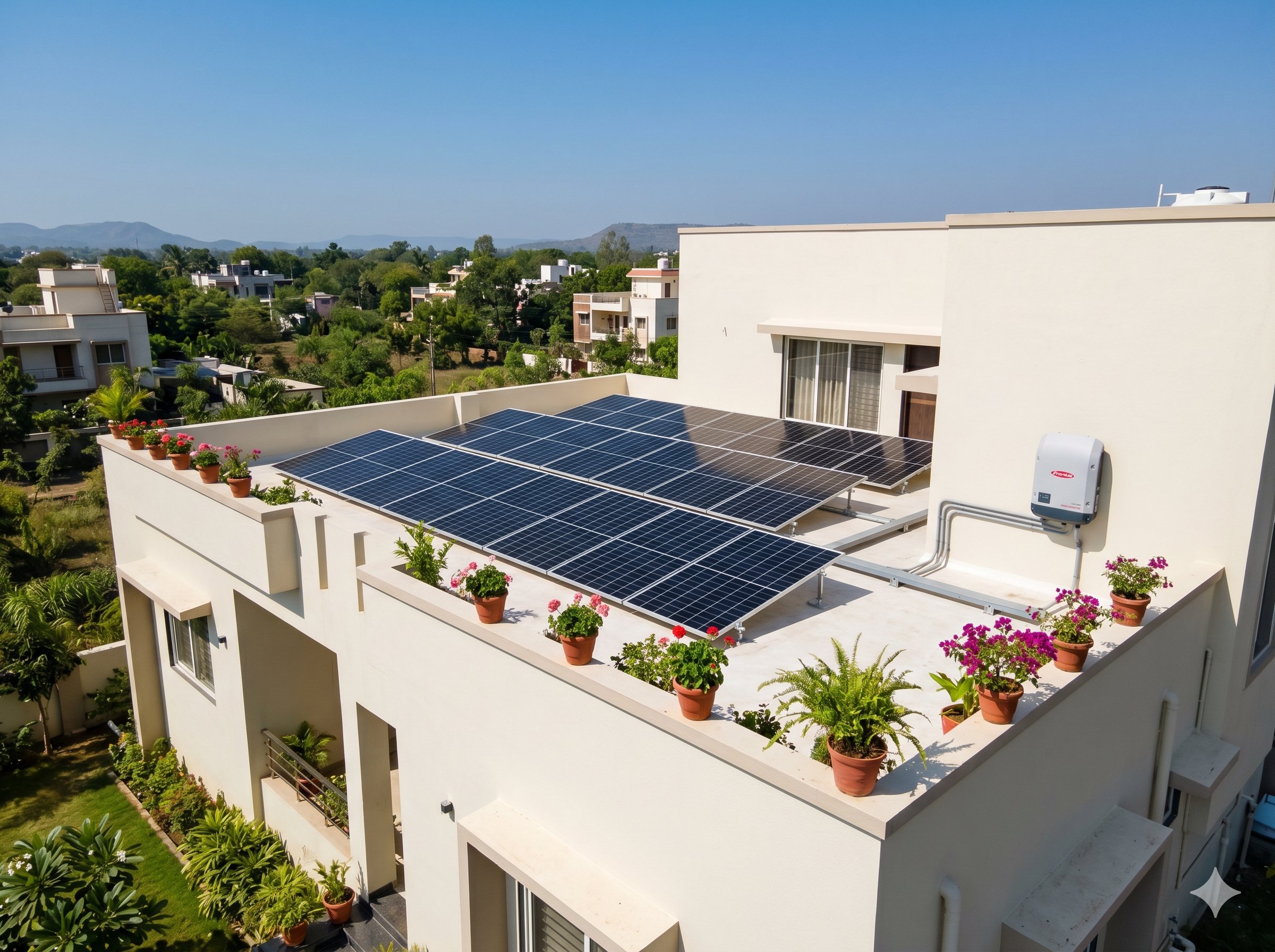
Photography
Real installations
6 completed in Bhandara district
About
Who we are
Wainganga Solar Works has been installing rooftop solar across Bhandara
district since 2018. We started as a small two-person electrical
contracting outfit serving farmhouses around Tumsar, and have grown to a
six-person crew with two certified electricians and a paperwork desk that
handles PM Surya Ghar subsidy and MSEDCL net-metering end-to-end.
We work mostly on residential rooftops between 2 kW and 6 kW — the size
most homes around the Wainganga belt actually need. We are
MSEDCL-empanelled and we use Tier-1 mono-PERC panels from Waaree and
Vikram, paired with Microtek or Luminous inverters depending on whether
the household needs battery backup for outages.
What we do not do: rush a quote, oversell capacity, or skip the site
survey. Every quote starts with a free rooftop visit, including a shade
study and a quick check of your old wiring. Bhandara summers are hot and
the monsoon is heavy — we will tell you on the spot if your roof needs a
slope correction or if mounting brackets will cost extra.
Subsidy disbursement under PM Surya Ghar currently takes 40–60 days in
Bhandara. We file the National Portal application for you and follow up
weekly. Payment terms: 30 percent on order, 50 percent on installation, 20
percent after net-metering. No advance demanded before the site survey.
A note on the February 2026 MSEDCL rule change: the portal now sizes your
approved system from your last 12 months of electricity bills, not your
future plans. If you are planning for EV charging or a new AC, bring two
years of bills to the site survey — we will help you build a usage case
to push for the right capacity. Most Bhandara homes still qualify for a
2–4 kW system without trouble.
Services
What we install
Rooftop residential
Commercial up to 25 kW
PM Surya Ghar subsidy
MSEDCL net-metering
AMC & maintenance
Battery backup add-on
FAQ
Common questions
Site survey to commissioning is typically 50–80 days. The
installation itself takes 2–3 days on the roof. The rest is paperwork —
MSEDCL net-metering application, the bidirectional meter installation by
their team (the slowest step, usually 30–40 days in Bhandara circle), and
the PM Surya Ghar subsidy filing on the National Portal. We handle all of
it; you only sign documents.
A 3 kW system in Bhandara runs ₹1.65–1.85 lakh before subsidy,
depending on panel brand and whether your roof needs structural prep. PM
Surya Ghar gives you ₹78,000 back for a 3 kW system. So your net cost
lands at ₹87,000 to ₹1.07 lakh. Payback is usually 4–5 years; panels are
warranted for 25.
Honest answer: the MSEDCL Bhandara circle has fewer section
engineers than Nagpur, so the net-meter installation step takes 10–15 days
longer on average. We cannot speed that up — what we can do is keep you
updated weekly on WhatsApp and make sure your application has zero errors
so it doesn't get bounced back.
Yes. A 3 kW system with a 5 kWh lithium battery (Luminous or Microtek) adds roughly ₹1.4–1.7 lakh to the bill, depending on chemistry and brand. Lead-acid is cheaper at ₹50–70k but lasts 4–5 years instead of 10+. In Bhandara we mostly recommend lithium for homes that lose 6+ hours of power a week during monsoon outages.
Panels carry the manufacturer's 25-year linear performance warranty and 12-year product warranty (Waaree or Vikram, both Tier-1). Inverters are 5-year warranty as standard, extendable to 10 years for ₹4–6k at purchase. Our own installation workmanship is covered for 2 years from commissioning — if a mounting joint loosens or a DC cable develops a fault, we fix it free.
Yes, but at reduced output. From mid-June through September, expect 30–50% less generation than the April peak — overcast skies cut irradiance, not the panels themselves. We use IP68-rated junction boxes and MC4 connectors with monsoon-grade gaskets, and we route DC cables in 25 mm conduit with drip loops to keep water out of the inverter end. Your annual yield in Bhandara still averages 1,450–1,550 kWh per installed kW — the monsoon dip is already baked into that number. We also include one free pre-monsoon panel cleaning in your first year to flush dust before the rains.
Get a callback
Tell us about your roof
The slow third path — for when you'd rather not call yet.
Contact
Reach us directly
Phone
+9194220 56781
WhatsApp
+9194220 56781
Email
hello@wainganga-solar.in
Address
Plot 7, Tirodi Road, Behind Jila Parishad Office, Bhandara 441904
For installers
Are you a solar installer in Bhandara?
Get a complete public profile with real reviews, photos, and a working lead form. No leads-per-month promises we can't keep.
© 2026 Saundarya Roof
Pune · Built for installers who do the work.